Introduction
Oh! Brother was first released as a single on 8th June 1984, and subsequently included as one of the seven bonus tracks on the cassette version of the album The Wonderful and Frightening World Of... (the cassette version had the alternate title Escape Route From The Wonderful And Frightening World Of The Fall), released on 12th October 1984.
However, it was an old song: set lists from Mark E. Smith's estate auctioned by Omega Auctions in recent years have shed much light on the early Fall, and have established that Oh! Brother was played at Rafters, Manchester, on 4 August 1977 - this is the earliest known performance. The earliest known recorded performance was at Band on the Wall, Manchester, on 13 November 1977; this was released on 25 November 2022 as disc 6 of Cherry Red's 12 CD The 1970s box set. The Live 1977 Cog Sinister/Voiceprint CD, first released in March 2000, captures a performance recorded at Stretford Civic Centre on 23 December 1977. This set has been re-released a couple of times, and is also on the The 1970s box set.
The last documented performance for about five years was at the Carlton Club, Warrington, on 13 November 1978 (a recording of this also appeared on the Cherry Red 1970s box set).
The evidence of bootleg recordings suggests that Oh! Brother was revived in November 1983 (at Madison, Middlesbrough, on 1 November) and played at gigs through to the end of the year. Then on 19th February 1984, The Fall recorded a version of the song for a David Jensen radio session which was broadcast on 1st March. The song was apparently next played live at Buster Brown's, Edinburgh, on 20th March (see: https://thefallliveblog.wordpress.com/category/live-tracks-list-and-count/oh-brother/).
Between the end of 1983 and the David Jensen session, the song had undergone significant evolution. Lyrically, a key change was the addition of a spoken-word German-language refrain with which Mark E. Smith now began the song and which he then repeated about half-way through.
The refrain appears not only on the session version and the version on record, but also on live performances from March 1984 onwards (as far as I can tell it is not heard live before that - but note that Mick Middles recalls the line from gigs at Band on the Wall in 1977, see: https://thequietus.com/articles/25199-the-fall-458489-singles-reissues-beggars-album-review, in which he comments that "I always thought he was singing about reviewers from Sounds."), all the way through to its final documented performance at Clitheroe Castle, Lancashire, on 16th June 1985.
The Lyrics Parade, the origins of which lie in the old Fallnet Usenet mailing list, was the Fall-fan community's attempt at crowd-sourcing Mark E. Smith's lyrics (an archived version can be found here). In 2014, the content was incorporated into The Fall Online Discography. It is no longer actively updated, and has been superseded by The Annotated Fall (http://annotatedfall.doomby.com/pages/the-annotated-lyrics/oh-brother.html). But the Lyrics Parade's valiant attempt to decipher the German refrain is preserved here:
Mecass, the mass, decline, domain, relan, drazan, my heart's blocked, rout
This was obviously wrong, so I set myself the challenge of working out what the line should really be.
Detective Instinct
MES's pronunciation and semi-whispered delivery make it difficult to discern the words clearly.
Apart from the Lyrics Parade, all I had to go on was the following, in Dave Thompson's book A User's Guide to The Fall (Helter Skelter, 2003, p.76):
anybody seeking to ascertain how Smith himself would deal with mass popularity needed only translate the pidgin German that echoes through 'Oh! Brother': 'I hate the crowd, the impotent crowd, the pliable crowd... who, tomorrow, will rip my heart out.'
This seems to have been based on information in the Beggars Banquet press release for the Oh! Brother single, from June 1984. Thompson may have had his own copy, but Philip Johnson had previously sent the text of the press release to Fall News, who had published it in an update dated 18th January 1998 (link 4). The relevant line reads:
Translation of the pidgin-German on track reads: 'I hate the crowd / The impotent crowd / The pliable crowd / Who tomorrow will rip my heart out.'
Here's a copy of the press release:
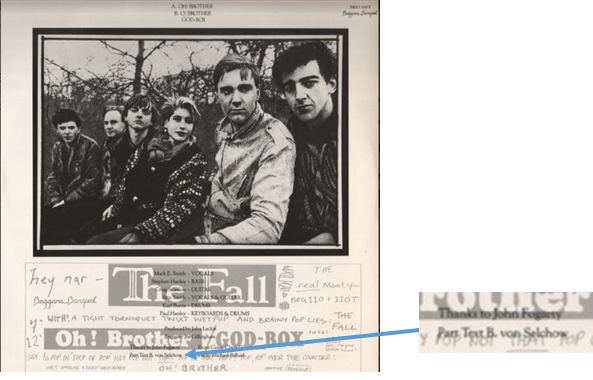
I spotted a second clue, hitherto apparently unnoticed and unremarked, hiding in plain sight on the reverse of the cover of the single.
"Part Text: B. von Selchow"
Armed with these clues, I was soon able to track down the original source of the refrain, and nail the right words for the first time.
News of my discovery of the correct text was posted to The Annotated Fall on 25th March 2017 (link 1), and I also wrote about it at the Fall Online Forum (link 2, link 3), which means the various elements of the story are all a bit tangled up, and the evidence and documentation spread about across several sites.
The rest of this post brings the story of the "Selchovian Refrain" together in one place, as clearly as possible.
Bogislav von Selchow - who he?
"B. von Selchow" is a very strange and disturbing figure to find acknowledged on a Fall record sleeve.
According to Wikipedia (link 5), Bogislav von Selchow (1877-1943) was a member of an aristocratic family who joined the Imperial German Navy in 1897. He retired from the navy in 1919, having been given the rank of frigate captain, and took up the study of history at Marburg University. At Marburg he founded a volunteer student militia (the Germany army having been dissolved), and led a violent right-wing paramilitary organization.
Although never a member of the Nazi party itself, Selchow was nonetheless a committed anti-semite and national socialist, as is evident from many of his writings, including his poetry. In 1948 he was described by Erik R. Von Kuehnelt as "one of the most popular nationalist authors in recent years." (Von Kuehnelt-Leddihn, E. (1948), p.343, note 13).
Selchow's poetry is still circulated among modern day Nazis and other extreme right-wingers, but is little known outside such circles. Only one of his poems (so far as I have been able to discover) seems to have been translated into English, at least in any mainstream publication - and this is the one which MES draws upon in Oh! Brother - it's called "Ich hasse die Masse".
Ich hasse die Masse
Selchow's poem originally seems to have originally been published in his 1922 anthology, Der Ruf des Tages ("The Call of the Day"), with the title "Ich hasse die Masse".
I obtained a copy of the book. Here is a scan of the front cover:
And here is a scan of the poem as it appears in the book:
(See also the bibligraphical information and contents pages of the book via the Deutsche National Bibliothek - link 6).
The poem was then subsequently reprinted (under the title "Die Masse") in the 11th/12th February 1923 issue of Völkischer Beobachter (p.14), the newspaper of the NSDAP - the Nazi Party (link 7). I managed to track it down using the microfilm copy held by the British Library.
Here is a transcript of the full text of the poem as it originally appeared in Der Ruf des Tages and Völkischer Beobachter (I've added line numbering).
(Thanks to Fall Online Forum user "Portsmouth Bubblejet" for his help with reading and translating the German script)
1.1 Ich hasse
1.2 Die Masse,
1.3 Die breite,
1.4 Gescheite,
1.5 Geschäftig und laut,
1.6 Die aus dem Gestern das Morgen braut.
2.1 Ich hasse
2.2 Die Masse,
2.3 Die enge
2.4 Menge,
2.5 Die auf ein Wort
2.6 Hurra ruft oder Fürstenmord.
3.1 Ich hasse
3.2 Die Masse,
3.3 Die kleine,
3.4 Gemeine,
3.5 Den Nacken gebeugt,
3.6 Die isst und schläft und Kinder zeugt.
4.1 Ich hasse
4.2 Die Masse,
4.3 Die lahme,
4.4 Die zahme,
4.5 Die heut an mich glaubt
4.6 Und die mir morgen mein Herzblut raubt.
There is of course more than one way to translate the poem.
Here is a fairly literal/neutral translation (thanks again to "Portsmouth Bubblejet" for his help and advice, but any errors are mine):
1.1 I hate
1.2 The masses,
1.3 The rank-and-file,
1.4 Clever,
1.5 Busy and loud,
1.6 Who brew tomorrow out of yesterday.
2.1 I hate
2.2 The masses
2.3 The narrow
2.4 Crowd,
2.5 Who in response to a word
2.6 Shout 'Hurrah!' or 'Death to the Prince!'
3.1 I hate
3.2 The masses,
3.3 The small,
3.4 Vulgar,
3.5 Who bow their heads,
3.6 Who eat and sleep and beget children.
4.1 I hate
4.2 The masses,
4.3 The lame,
4.4 The tame,
4.5 Who believe in me today
4.6 And who tomorrow will steal my lifeblood.
Here's another, less competent, attempt by me (plus some alternatives), just to illustrate the point:
1.1 I hate
1.2 The mass (or "hoi polloi"),
1.3 The common folk,
1.4 Sly,
1.5 Industrious (or "hard working") and noisy,
1.6 Brewing tomorrow out of yesterday.
2.1 I hate
2.2 The masses,
2.3 The cramped
2.4 Crowd,
2.5 Who at a word
2.6 Cry "hurrah!" or "regicide"
3.1 I hate
3.2 The masses,
3.3 The little men,
3.4 Dirty,
3.5 Their heads bent back,
3.6 Who eat and sleep and breed.
4.1 I hate
4.2 The masses,
4.3 The lame,
4.4 The tame,
4.5 Who believe in me today
4.6 And tomorrow will rob me of my lifeblood (or "tear out my heart").
Listening carefully to Oh! Brother with the poem in front of me, it was easy to work out what Mark E. Smith is saying (I've used line numbering again to make it more obvious where each line comes from):
3.1 Ich hasse,
3.2 Die Masse,
3.3 Die kleine,
3.4 Gemeine,
4.3 Die lahme,
4.4 Die zahme,
4.6 Mein Herzblut raubt.
In other words, MES speaks the first four lines of the third verse, followed by the third, fourth and part of the sixth lines of the fourth verse (the first two lines, "Ich hasse/Die Masse", are of course the first two lines of each of the four verses of the original, but for convenience I have chosen to start numbering from the third verse.)
Sticking to the Portsmouth Bubblejet-assisted translation, the Oh! Brother refrain would translate as follows:
3.1 I hate
3.2 The masses,
3.3 The small,
3.4 Vulgar,
4.3 The lame,
4.4 The tame,
4.6 Steal my lifeblood.
But remember that the Oh! Brother press release offers the following translation:
I hate the crowd / The impotent crowd / The pliable crowd / Who tomorrow will rip my heart out
It is evident that the Beggars Banquet press release is not an accurate translation of the Selchovian refrain as it is heard in Oh! Brother. It omits any translation of lines 3.3 and 3.4, which appear in the lyric, and includes the "tomorrow" element, which appears in the poem (4.6) but not in the lyric. The press release, therefore, is offering a translation of part of the fourth verse of the poem, rather than of what Mark E. Smith really says.
That means that whoever provided the translation for the press release was not (or not just) working from what can be heard on record. Even though what can be heard is unclear, to include a word that cannot be heard is an implausible coincidence unless the author of the press release had access to the text, or part of the text, of the poem itself, or at least to the two verses that Mark E. Smith plundered for the lyric.
It seems unlikely (if not completely impossible) that the source was the original German text as it appeared in either Der Ruf des Tages or Völkischer Beobachter. Neither source would have been easily accessible to MES.
And as shall become apparent, it is likely that the source being used included both the German text and a parallel English translation.
Possible sources
There are not many English-language sources in which the poem could have been found. In this section I review the possibilities.
Konrad Heiden
Konrad Heiden (link 9) was born in Munich in 1901. Working as a journalist in the Weimar Republic, he witnessed the rise of National Socialism and wrote several books on the history of Nazism as well as biographies of Hitler and other anti-fascist works. A social democrat, he fled Germany when the Nazis seized power in 1933 and eventually escaped into exile in the United States, where he died in 1966.
Selchow's poem seems to have entered the consciousness of the English-speaking world via Heiden's Geschichte des Nationalsozialismus: Die Karriere einer Idee. (History of National Socialism: the career of an idea, Berlin: Rowohlt Verlag, 1932 [original German text]). That book, along with Heiden's sequel, Geburt des dritten Reiches: Die Geschichte des Nationalsozialismus bis Herbst 1933 (Birth of the Third Reich: the history of National Socialism to Autumn 1933, Zürich: Europa Verlag, 1934), became regarded as standard authorities on the subject and were widely reviewed and cited (they were also criticised for not citing their sources, along with various historical errors and confusions, but nonetheless they were among the first, if not the first, and by default pre-eminent in their field for many years).


Geschichte des Nationalsozialismus ended its narrative in 1930; the sequel brought the story up to date.
It is Geschichte des Nationalsozialismus in which Heiden quotes the third and fourth verses of Selchow's poem (see p.93-94 of the German original, above).
In 1934, Methuen published an English translation of an edited combination of the two books.
There is an intriguing note about the English translation in the entry on Heiden in Current Biography: who's news and why, 1944 (Rothe, 1945, p.282):
Trying to impress unconcerned democratic leaders with the virulence of Nazism, Heiden also wrote A History of National Socialism, which was suppressed and publicly burned. It is still a standard work outside Germany. (Published in the United States in 1935 by Alfred A. Knopf, A History of National Socialism is the joint translation of Heiden's two books, Geschichte des Nationalsozialismus [1932] and Geburt des dritten Reiches [1934].) Meanwhile, the rights had been sold to an English publishing house. "But when I got to London a year later," say Heiden, "I found that the book had not been translated and that my publishers had almost forgotten its existence." Baffled by this situation, he questioned his agent, only to learn that "the publishers were reluctant to issue a book about a dictator who tomorrow may be overthrown."
(There was also a French translation published in 1934 by Librairie Stock, with the title Histoire du national socialisme: 1919-1934. The translator was Armand Pierhal, and the book included a preface by Julien Benda. I haven't seen a copy so I don't know if it was also a combined edition of both Heiden's books).
Curiously, opinion was divided as to the quality of the anonymous translation. Arnold J. Zurcher's review of the Knopf edition (Zurcher, 1935, pp.679-680) criticises it (pp.679-680):
It is a cause for some regret that the publisher's sense of economy and his inability to secure a competent translator should have resulted in this work being rendered into English so reduced in substance and in a style which suffers acutely from grammatical errors and from a failure to appreciate English idiom.
But E.J. Passant, reviewing the 1934 Methuen edition, praised it (Passant, 1934, p.495):
The translation of the German version is accurate and easy...
I have not been able to discover the identity of the English translator.
The translator's note, in the beginning of the book, reads:
This translation has been made from Herr Heiden's two books, Geschichte des Nationalsozialismus (1932) and Geburt des dritten Reiches (1934). In making it, the Translator has been careful to avoid altering the sense of Herr Heiden's text. All that has been done is to omit portions, chiefly relating to the earlier history of the Nazi movement, for the purpose of keeping the English translation within a reasonable compass.
Here's a page image of the 1934 Methuen edition showing the original and translated versions of the poem (p.79):
In 1935, Alfred A. Knopf of New York published the same translation, but with the addition of a final chapter. The translator's note was as above, with the addition of this final sentence:
A "Final Chapter" has been added, to include events subsequent to the original publication of this work.
A facsimile reprint of the Knopf edition was published by Methuen in 1971. A US edition of the same reprint was published by Octagon Books of New York the same year.
The same edition was reprinted by Routledge in 2010, as volume 2 of their "Routledge Library Editions: Responding to Fascism" series. There was a paperback edition in 2013.
Here is how the third and fourth verses of Selchow's poem are rendered in the Methuen/Knopf translation (p.79 of the 1934 Methuen edition, p.89 of the Knopf edition, p.122 of the Routledge edition):
3.1 I disdain
3.2 The profane,
3.3 Plebeian,
3.4 And mean,
3.5 Servile of gait,
3.6 That eat and sleep and procreate.
4.1 I disdain
4.2 The profane,
4.3 The weak,
4.4 The meek,
4.5 That are loyal to-day
4.6 And to-morrow will swear my life away.
Was one of the editions of the English translation of Heiden's work MES' source for Selchow's poem? Given the significant differences between the Heiden translation and the press release translation, it would seem not. MES must have have had access to a different translation.
Rowse's Variant
[The Jonathan Cape hardback edition, 1976, with the title in yellow. And the Quality Book Club hardback edition, 1977, with blue background.]
The British historian A.L. Rowse (
link 8) included a short untranslated extract from the poem in his literary/biographical 1976 book,
A Cornishman Abroad (p.62):
Ich hasse die Masse, die kleine, die gemeine,
Den nacken gebeugt,
Die isst und frisst und kinder zeugt.
No source is given. Evidently the extract is based on the third verse of the original poem, but the German text given by Rowse departs from the original.
"Gemeine" (line 3.4) becomes "die gemeine", and instead of "Die isst und schläft... " ("Who eat and sleep") in line 3.6, Rowse has "Die isst und frisst...". "Isst" is derived from "essen" and straightforwardly means "eats", but "frisst" comes from "fressen", and is used for animals eating, or humans eating like animals - faces in the pig trough, perhaps, an indication of greed or stuffing oneself. "Isst" is apparently considered polite, but "frisst" is derogatory.
Since Rowse provides no explanation of where this variant text comes from (perhaps just poor memory), we can do no more than note that Rowse is obviously not MES' source.
Heinz Höhne: the most likely source so far identified
Heinz Höhne's The Order of the Death's Head: The Story of Hitler's SS, contains the closest translation to that used by MES that I have found so far. I believe it to be MES' source.
The Order of the Death's Head was originally published in German under the title Der Orden unter dem Totenkopf in 1966/7, and first published in English translation by Secker and Warburg in 1969 (it has been through a number of reprints and editions since then).


I have the Pan Books paperback edition of 1972, in which the poem can be found on p.15. The translator, Richard Barry, renders it as:
3.1 I hate
3.2 The crowd
3.3 The little men
3.4 The mean men
3.5 Who bow their heads
3.6 And eat, sleep and beget children
4.1 I hate
4.2 The crowd
4.3 The impotent crowd
4.4 The pliable crowd
4.5 Which believes in me today
4.6 And tomorrow will tear my heart out
Heinz Höhne's cited source for the poem is Konrad Heiden's Geschichte des Nationalsozialismus: Die Karriere einer Idee (i.e. the original German work).
The only difference between Barry's translation of Höhne and the translation used in the Beggars Banquet press release is that "... mein Herzblut raubt" (line 4.6) is translated as "... tear my heart out" by Barry and "... rip my heart out" by the press release.
Given that the press release's translation is clearly not based on what can be heard on record, since it includes words that don't appear in the lyric, and given that what it does provide is remarkably close to the Barry translation (bearing in mind the many different ways the poem can be translated), it strikes me as plausible to imagine that whoever was responsible had the Höhne book (or a note based on the book) in front of them, and either mistakenly replaced "tear" with "rip", or maybe preferred the latter word.
On the basis of the evidence in front of us, I think MES's source is probably The Order of the Death's Head (or, alternatively, another currently unknown source which quotes Barry's translation of Selchow). It is possible that another source exists which translates the poem exactly as Richard Barry did, apart from the single word "rip" instead of "tear". But given the range of possible translations, an identical-to-Barry-except-for-one-word version would seem unlikely.
References
Passant, E.J. (1934). Review: Konrad Heiden, A History of National Socialism. in The Economic Journal, vol. 44 (175), September, pp.494-495.
Rothe, Anna (ed.) (1945). "Heiden, Konrad", in Current Biography: who's news and why, 1944. New York: H.W. Wilson Company, pp.282-284. Online at archive.org.
Von Kuehnelt-Leddihn, E. (1948). The Bohemian Background of German National Socialism: The D.A.P., D.N.S.A.P. and N.S.D.A.P.
Journal of the History of Ideas, 9 (3), pp.339-371. doi:10.2307/2707374.
Zurcher, Arnold J. (1935). Review: Konrad Heiden, A History of National Socialism. in The American Political Science Review, Vol. 29 (4), August, pp.678-680.
Bibliography
Rowse, A.L. (1976). A Cornishman Abroad. London: Jonathan Cape.
Selchow, Bogislav von (1922). Der Ruf des Tages: Gedich. Marburg: NG Elwert'sche Verlag.
Selchow, Bogislav von (1923). Die Masse. Völkischer Beobachter, 11th/12th February, p.14.
Thomson, Dave (2003). A User's Guide to The Fall. London: Helter Skelter.
Updates
26/2/2024 - added new information about early performances.